A BFI-backed India–UK collaboration is using generative AI, game-engine technology and immersive media to reimagine colonial-era images of India, turning archival footage held in Britain into speculative visions of South Asian futures.
Elsewhere in India, created by Indian artists Murthovic and Thiruda, has emerged through an ongoing collaboration with the BFI National Archive. The project draws on the BFI’s India on Film: 1899–1947 collection, combining archival moving images with AI-augmented world-building, game-engine cinematics, electronic music and immersive experiences.
The project’s most distinctive idea is what the BFI calls “digital repatriation”: rather than treating colonial-era footage simply as historical evidence, the artists take material from a Western archive and creatively recontextualise it to construct new narratives about South Asian heritage.
The BFI describes Murthovic and Thiruda’s approach as “turning the colonial gaze into Indofuturist docufiction”. The artists are not positioning themselves as historians. Instead, they use the archive as raw material for speculative world-building, asking what South Asian stories might emerge when images produced through a colonial gaze are placed inside imagined futures.
That approach also makes the project an unusual case study in the emerging relationship between artificial intelligence and cultural archives. The BFI says it has been exploring the idea of “AI for cultural good”, while also considering broader questions about AI, decolonising collections practice and what a screen archive of the future might look like.
From archival footage to 2079
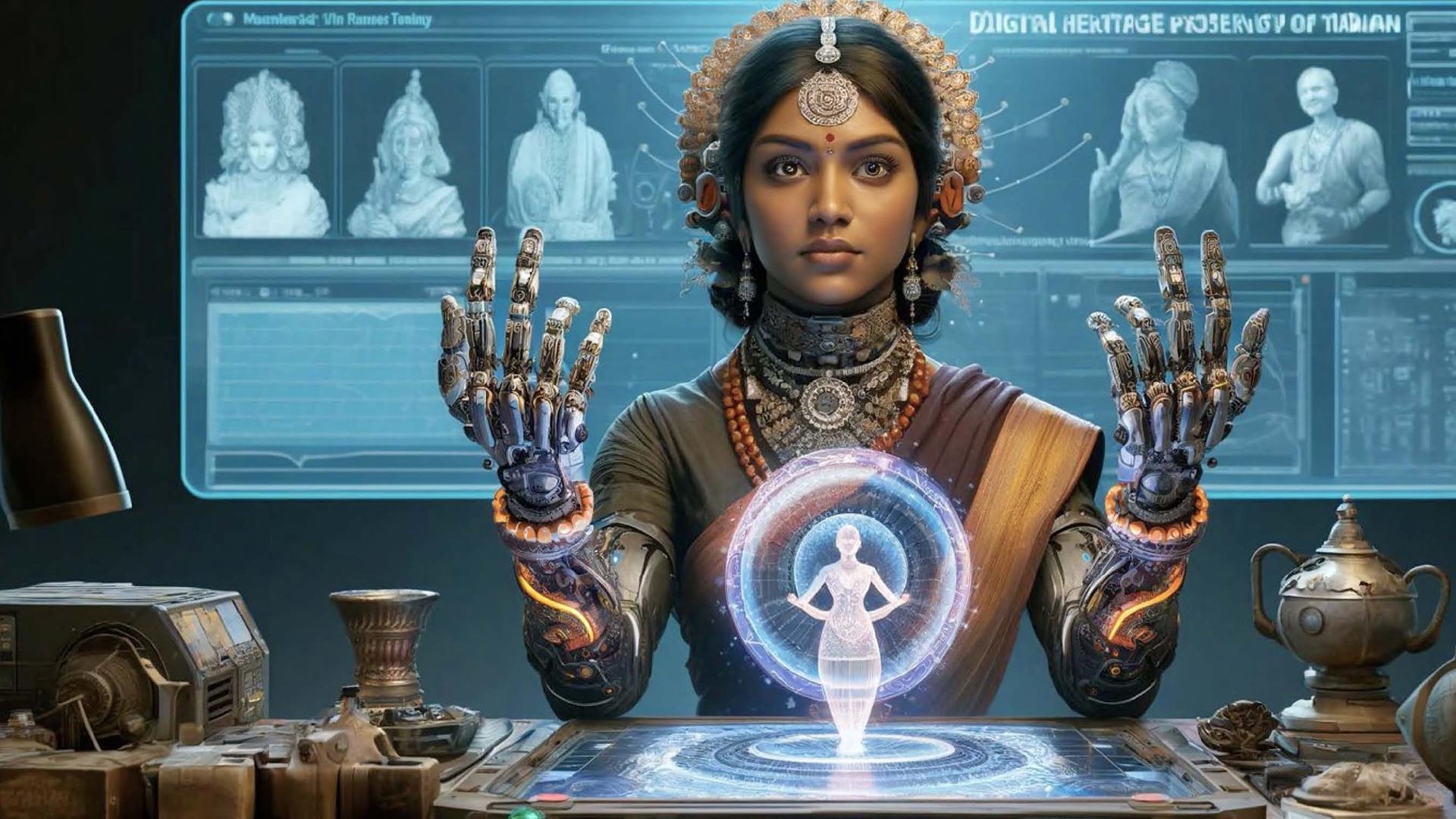
Elsewhere in India is set partly in an imagined India of 2079, where cultural memory is under threat. Its central figure, Meenakshi, is described as a “cultural cyborg” created to preserve Indian heritage. The wider project combines AI art, 3D environments, motion-captured dance, video-game technology and electro-classical music.
The latest iteration was presented at Sheffield DocFest 2026, where it appeared both as a live performance and as part of the festival’s Alternate Realities exhibition. The exhibition presented three interconnected works: A Road in India 2079, a panoramic video installation that reimagines a BFI silent travelogue as speculative cinema; Meena XR, an immersive experience set in 2079; and Elsewhere: Heritage Arcade, a digital museum built inside Fortnite.
The project has been evolving for several years. It was previously presented through the 2023 BFI London Film Festival’s LFF Expanded programme and has subsequently travelled through exhibitions and performances. The BFI says possible future extensions include a video game, a full-dome experience and a linear feature film.
An India–UK collaboration
The project originated with British Council support and was developed by Delhi-based Antariksha Studio and UK producer Crossover Labs. The British Council describes it as an India–UK collaboration focused on transmedia storytelling, cultural preservation and digital restitution.
The BFI subsequently became an international partner, supporting the project from 2023 onwards. At Sheffield DocFest, BFI producer Simon McCallum participated alongside the artists in a discussion about the collaboration and the implications of working with colonial archival material as world-builders rather than historians.
The significance of Elsewhere in India therefore goes beyond its use of generative AI. The project proposes a different relationship between archives and contemporary creators: instead of merely preserving the colonial record or restoring damaged images, artists can use archival material to challenge the perspective through which that record was originally created.
For the BFI, that raises a larger institutional question about the future of screen heritage. For the artists, the archive becomes a starting point for imagining futures in which South Asian communities can reclaim, distort and reinvent images inherited from the colonial past.
Elsewhere in India suggests that one possible form of digital repatriation is not necessarily the physical return of an object, but the creation of new cultural meaning around it.