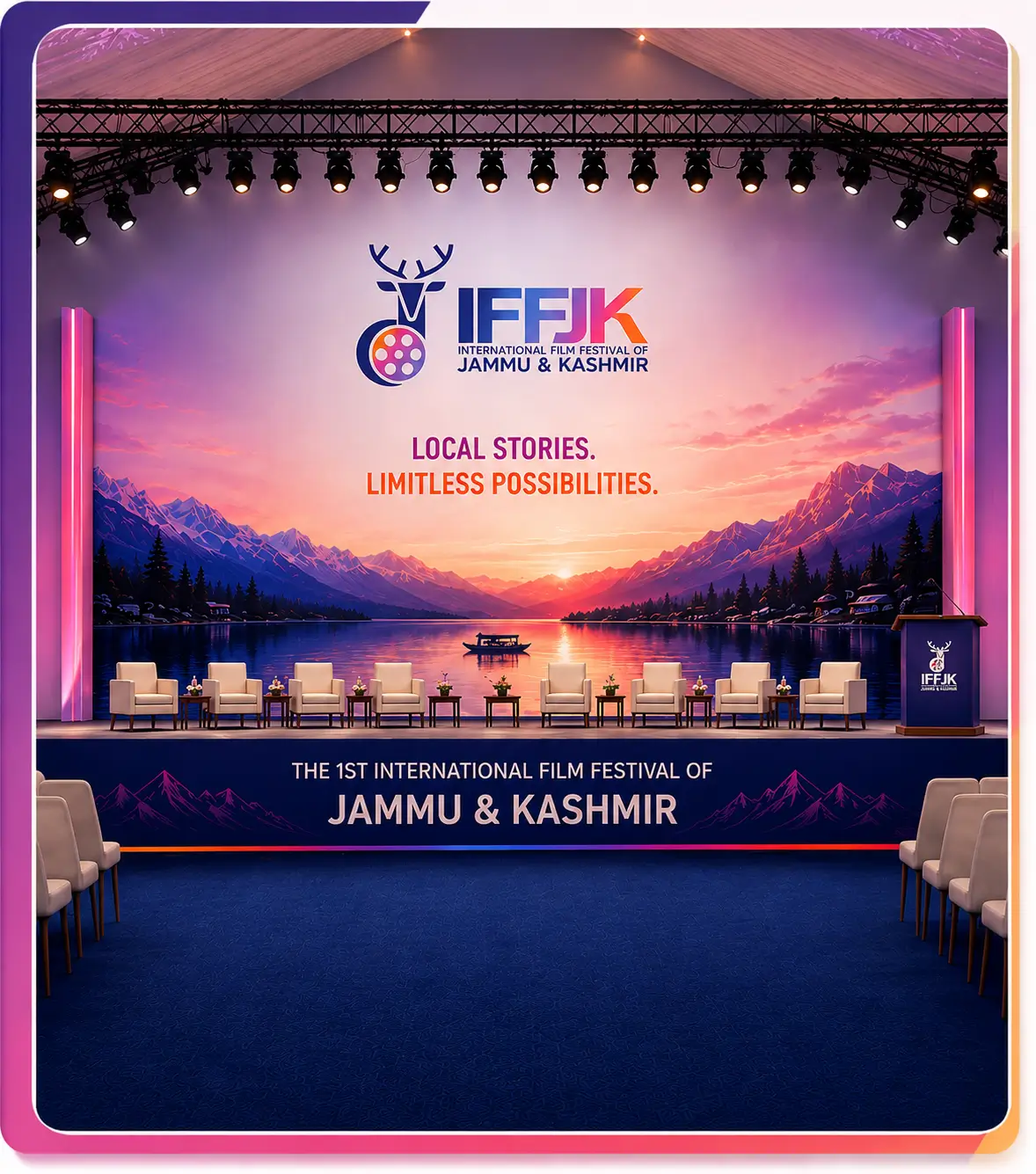
The inaugural International Film Festival of Jammu & Kashmir (IFFJK) will open on September 7 with 135 films from 41 countries and a total cash-award purse of ₹96 lakh across nine categories, establishing the new event as a fully programmed international festival rather than a proposed initiative.
The four-day festival, running September 7–10, will take place across SKICC in Srinagar, Gulmarg and Jammu. J&K Chief Secretary Atal Dulloo reviewed final preparations on August 27, with the government positioning IFFJK as an annual international event aimed at establishing Jammu & Kashmir as a destination for cinema, cultural exchange and creative activity.
Indian films make up 64 of the 135 titles in the programme. France follows with 13 films and Iran with eight, while Argentina and Spain have four each. Brazil, Germany, Russia and the US are represented by three films apiece, alongside selections from countries including South Korea, Sweden, Taiwan, Qatar, Colombia and Türkiye.
The festival has announced a five-member international jury chaired by cinematographer and filmmaker Santosh Sivan. The panel includes Resul Pookutty, the Oscar- and BAFTA-winning sound designer; German filmmaker, curator and long-time Berlin International Film Festival programmer Dorothee Wenner; Japanese filmmaker, producer and international curator Keiko Bang; and National Award-winning filmmaker and educator Himansu Sekhar Khatua.
Sivan brings extensive filmmaking credentials to the inaugural jury. A founding member of the Indian Society of Cinematographers, he has directed films including The Terrorist and received the Pierre Angénieux Tribute at Cannes in 2024. Pookutty won the Academy Award for Slumdog Millionaire and has also received a BAFTA, Padma Shri and National Film Award. Wenner contributes substantial international festival and curatorial experience through her work with the Berlinale, while Bang brings expertise in documentary filmmaking and Asian co-productions. Khatua, a National Award-winning filmmaker, is a former director of the Satyajit Ray Film and Television Institute.
The jury will adjudicate the festival’s international, national and Jammu & Kashmir-focused competition categories. Its composition reflects IFFJK’s dual ambition: to build an international profile while creating a dedicated platform for regional cinema.
₹96 lakh in cash awards
IFFJK has announced a total prize purse of ₹96 lakh across nine categories:
- Best Film: ₹25 lakh
- Best Director: ₹15 lakh
- Best Debut Film of a Director: ₹15 lakh
- Best Film – J&K Select: ₹10 lakh
- Best Actor (Male): ₹8 lakh
- Best Actor (Female): ₹8 lakh
- Best Cinematography: ₹5 lakh
- Best Sound Design: ₹5 lakh
- Best Editing: ₹5 lakh
The ₹25 lakh Best Film award is the festival’s largest individual prize. The ₹15 lakh awards for Best Director and Best Debut Film of a Director place equal emphasis on established filmmakers and first-time directors. The ₹10 lakh J&K Select award is intended to recognise films connected to the region.
The acting awards are worth ₹8 lakh each, while cinematography, sound design and editing receive ₹5 lakh apiece. The prize structure therefore extends significant monetary recognition beyond films and directors to performers and below-the-line craft.
The festival will also host masterclasses and industry sessions, with announced participants including director Vidhu Vinod Chopra, editor Namrata Rao, sound designer Baylon Fonseca, NSD’s Chittranjan Tripathi, documentary filmmaker Supriyo Sen and cinematographer Anil Mehta. A Canon workshop is also planned.
Among the festival’s more distinctive initiatives is a floating screen on Dal Lake near SKICC, designed to combine film exhibition with the region’s landscape and tourism proposition.
For filmmakers, IFFJK’s immediate significance is that it has moved beyond the proposal stage. Its inaugural edition now has a defined international jury, a substantial cash-award structure and a confirmed 135-film programme. The September festival will test the quality of its competitions, its ability to attract filmmakers and international industry delegates, and whether its inaugural infrastructure can develop into a credible recurring festival platform.